

The IND vs NZ 2nd T20I Prediction is a fascinating follow-up to a remarkable opening match in Christchurch. India begin Saturday’s encounter with a 1–0 series lead after chasing down 226 to beat New Zealand by four wickets on 22 October 2026. The teams meet again at Hagley Oval, where aggressive batting and costly bowling spells defined their first contest. Sanju Samson and Naman Dhir were crucial to India’s chase, while Glenn Phillips gave the hosts a formidable total with an unbeaten 82. The second T20I offers New Zealand an immediate chance to respond and India an opportunity to move two matches clear. This preview examines the probable playing XIs, pitch conditions, key individual contests and the factors that may decide the game. Every projected team selection and match outcome remains subject to conditions and the official toss announcements.
| Match detail | Information |
|---|---|
| Fixture | New Zealand vs India, 2nd T20I |
| Date | 24 October 2026 |
| Venue | Hagley Oval, Christchurch |
| Series status | India lead 1–0 |
| First-match result | India won by four wickets |
| Teams | Official XIs pending toss |
Match Preview: Why the Second T20I Matters
The IND vs NZ 2nd T20I Prediction begins with an unusually simple question: can New Zealand stop India’s batting momentum without losing the attacking style that produced 225 runs in the opener? The teams return to Hagley Oval on Saturday, 24 October 2026. India carry a 1–0 advantage in the five-match series after a dramatic four-wicket win at the same ground.
For the IND vs NZ 2nd T20I Prediction, the immediate question is whether India can repeat their aggressive start or whether New Zealand can make earlier breakthroughs.
The opening contest offered both teams reasons for encouragement and reasons for concern. New Zealand produced a strong batting display, yet their bowlers could not defend 225. India completed a demanding chase, but their bowling unit conceded boundaries regularly.
That contrast makes the rematch particularly interesting. A second Indian victory would establish a 2–0 lead; a New Zealand victory would restore parity before the tour moves to Wellington. Neither outcome is assured.
The toss, bowling plans and the quality of execution during the first six overs may influence the direction of the contest.
What the First T20I Revealed
The first game delivered a combined 455 runs. New Zealand finished on 225/4 from 20 overs, and India replied with 230/6 in 19.4 overs. Those figures describe a high-scoring contest, but the scorecard also reveals how differently the innings developed.
These innings provide a useful baseline for the IND vs NZ 2nd T20I Prediction, but the second match will depend on fresh conditions and decisions.
New Zealand reached 65 in their six-over powerplay. India raced to 94 during the corresponding period, creating a major early advantage in a chase that eventually became tense. New Zealand’s Glenn Phillips remained unbeaten on 82 from 40 deliveries, hitting eight fours and three sixes.
Finn Allen contributed 45 from 24 balls, while Bevon Jacobs made 31 from 16. Their contributions ensured the hosts had a target that would normally place significant pressure on a visiting side. India responded through a 93-run opening partnership between Sanju Samson and Abhishek Sharma.
Samson scored 67 from 33 deliveries, Abhishek made 29 from 12, and captain Shreyas Iyer added 42 from 28. Naman Dhir’s unbeaten 42 from 15 balls supplied the final acceleration. The chase also included a period of instability.
India moved from 93/0 to 122/4, demonstrating that New Zealand’s bowlers could disrupt the innings even after a difficult start. For the second match, the visitors will want fewer collapses, while the hosts will want to take their chances much earlier. A score above 200 is possible again, but one exceptionally productive match does not establish that every subsequent innings will follow the same pattern.
| First T20I | New Zealand | India |
|---|---|---|
| Final score | 225/4 (20 overs) | 230/6 (19.4 overs) |
| Powerplay runs | 65 | 94 |
| Top scorer | Glenn Phillips 82* | Sanju Samson 67 |
IND vs NZ 2nd T20I Prediction: Christchurch Pitch Report
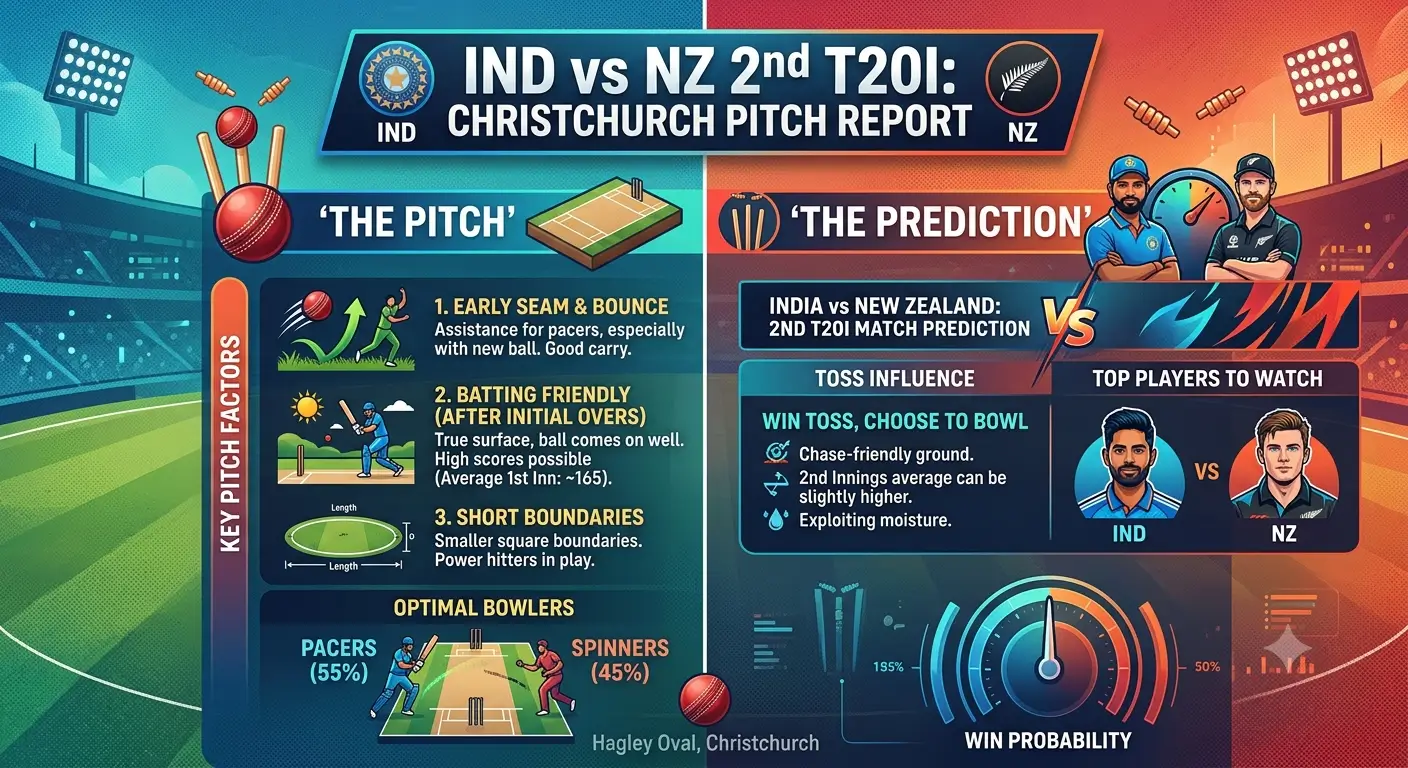
Hagley Oval has already provided evidence of a batting-friendly surface in this series, although conditions can change between matches. The first game’s 455 combined runs suggest that batters were able to score quickly when they found the right lengths. That is a match-specific observation, not a guarantee of identical pace, bounce or movement on Saturday.
Fast bowlers may still find help with the new ball if there is moisture in the surface or movement through the air. Seam position and disciplined lines can be especially important when batters are looking to attack from the first over. Bowlers who miss their lengths may find that the short format offers little time to recover.
The venue’s dimensions also make running between wickets and boundary placement important. Batters do not have to rely entirely on sixes to sustain a strong scoring rate. A team that rotates the strike can force field changes and create better boundary opportunities later in the over.
Weather is another variable. Cloud cover, wind, temperature and the possibility of moisture should be checked against a current local forecast closer to the toss. This article does not assume a particular weather condition will occur.
The captain who wins the toss will need to judge the actual pitch rather than simply copy the decision from the previous match. The most useful pitch-report conclusion is therefore conditional: batting looked productive in the opener, but the balance between seam and strokeplay must be assessed again on match day.
India Probable Playing XI and Team Strategy
India’s first-match XI provides the strongest available reference point for a probable side, but it is not an official selection announcement for the second fixture. Captain Shreyas Iyer and wicketkeeper Sanju Samson were central to the chase. Abhishek Sharma’s early aggression helped the visitors build a powerful platform, and Naman Dhir’s late hitting made the difference when the target still looked challenging.
India’s team balance remains central to the IND vs NZ 2nd T20I Prediction, particularly if late selection changes alter the batting order.
A continuity-based possible XI is Sanju Samson (wk), Abhishek Sharma, Tilak Varma, Shreyas Iyer (c), Ishan Kishan, Axar Patel, Naman Dhir, Nitish Kumar Reddy, Bhuvneshwar Kumar, Arshdeep Singh and Mayank Yadav. Availability and fitness must be checked at the toss; alternatives from the announced squad include Shivam Dube, Vaibhav Sooryavanshi, Varun Chakaravarthy and Kuldeep Yadav. The listed order is a proposed arrangement, not a confirmed batting order.
India may consider adding a specialist spin option if the surface appears slower. That choice would alter the balance between batting depth and bowling variety. The biggest question is not whether the side can score quickly; the opening game has already demonstrated that ability.
It is whether India can keep New Zealand below a demanding total without placing the entire burden on a successful chase. Arshdeep Singh, Bhuvneshwar Kumar and Mayank Yadav offer contrasting fast-bowling styles, while Axar provides left-arm spin and batting flexibility. Their execution at the start and finish of an innings could decide how much pressure the Indian batters face.
| India selection group | Players |
|---|---|
| Top order | Samson, Abhishek, Tilak |
| Middle order | Shreyas, Ishan, Axar, Dhir, Nitish |
| Specialist pace | Bhuvneshwar, Arshdeep, Mayank |
New Zealand Probable Playing XI and Selection Questions
New Zealand have several proven attacking players, but their bowling plans will attract attention after the opener. Mitchell Santner captains the side and gives the hosts a spin option who can also contribute lower-order runs. Michael Bracewell offers another spin-bowling all-rounder and took two wickets in the first game.
New Zealand’s response is equally important to the IND vs NZ 2nd T20I Prediction, with bowling roles and field placements likely to be reviewed.
Finn Allen, Tim Seifert and Glenn Phillips give New Zealand opportunities to accelerate at different stages. A continuity-based probable XI is Finn Allen, Tim Seifert (wk), Daryl Mitchell, Glenn Phillips, Bevon Jacobs, Michael Bracewell, Mitchell Santner (c), Nathan Smith, Adam Milne, Matt Henry and Lockie Ferguson. This is a projected XI, not a confirmed team sheet.
New Zealand Cricket’s pre-series injury update, reported by the ICC, ruled Mark Chapman and Zak Foulkes out of the T20I series, with Josh Clarkson and Blair Tickner named as replacements in the squad. That matters when assessing possible changes. The hosts could look at a different pace combination, but any adjustment should reflect conditions and player readiness.
Their central challenge is finding early wickets without giving away the high number of scoring opportunities that India enjoyed in the powerplay. Santner and Bracewell combined for four wickets in the first match, suggesting spin can interrupt the visitors’ rhythm. New Zealand need those breakthroughs to arrive before the chase is firmly established.
They must also consider whether the batting order is making full use of its available hitters. Phillips was outstanding in the opener; another strong contribution would help, but a balanced innings should not depend on one player producing a standout score every time.
| New Zealand selection group | Players |
|---|---|
| Top order | Allen, Seifert, Mitchell |
| Middle order / spin | Phillips, Jacobs, Bracewell, Santner |
| Pace options | Smith, Milne, Henry, Ferguson |
Five Player Battles to Watch
The IND vs NZ 2nd T20I Prediction becomes more interesting when the game is broken into smaller contests. The first is Sanju Samson against Mitchell Santner. Samson attacked aggressively in the opening match, but Santner dismissed him.
Individual contests offer another angle on the IND vs NZ 2nd T20I Prediction, especially in the powerplay and at the death.
Their next encounter could determine whether India preserve their powerplay momentum into the middle overs. Second, Finn Allen’s attacking approach against Axar Patel is worth following. Allen made 45 in the first game before Axar removed him.
If Allen survives that challenge, New Zealand could again produce a rapid start. Third, Glenn Phillips against India’s pace bowlers is a contest of boundary control. Phillips finished unbeaten on 82, showing he can maintain a high scoring rate while batting deep.
India need to vary their pace and field placements rather than repeat predictable lengths. Fourth, Naman Dhir against New Zealand’s death bowling is an important late-innings matchup. His 42 from 15 balls transformed the final phase of India’s chase.
New Zealand will want to deny him easy access to his preferred hitting areas. Fifth, Michael Bracewell against India’s left-handed batters offers a tactical question. Bracewell claimed two wickets in the opener, and his overs could help the hosts slow India’s scoring when field restrictions are lifted.
These battles are analytical talking points, not promises that the same players will face each other in identical circumstances. Matchups depend on the final XI, batting order, wickets and bowling changes.
Three Numbers That Shape the Match Prediction
The most useful figures come from the first T20I rather than from an invented probability model. India scored 94 runs in the powerplay compared with New Zealand’s 65, a difference of 29 runs. That advantage did not make the chase effortless, but it gave India flexibility when wickets fell later.
The second number is the combined wicket count: New Zealand lost four, while India lost six. The hosts preserved wickets, yet the visitors scored faster. This illustrates why wickets alone cannot explain a T20 innings; scoring tempo matters as much as survival.
The third number is the contribution of the leading scorers. Phillips made 82 for New Zealand, while Samson made 67 for India. Both performances were important, but they occurred in different match situations.
The charts below display these verified first-match figures and are not forecasts for the second T20I. A reader should avoid treating one match as a large historical sample. Team combinations, pitch wear, weather and the toss may all change the conditions under which those figures were produced.
The data provide useful questions to ask before the rematch: can India repeat a 94-run powerplay, can New Zealand take wickets sooner, and can the hosts defend a competitive total more effectively?
Who Will Win the Second T20I?
India enter with a narrow advantage because they have already shown they can chase a substantial target at this venue. Their batting order includes several players capable of changing the scoring rate quickly, and the opening win should give the group confidence. New Zealand, however, have a credible route to victory.
Their batters put 225 on the board, their spin bowlers made important breakthroughs, and a stronger powerplay with the ball could make the next chase very different. The hosts also know the ground and can adapt their bowling lengths after seeing how India approached the first match. The toss may influence tactics, but it should not be treated as an automatic deciding factor.
A captain choosing to field still needs disciplined bowling, while a captain choosing to bat needs enough runs to withstand a possible late assault. The final assessment is a slight lean toward India, not a numerical winning probability or a guaranteed result. If New Zealand dismiss one or both Indian openers early and control the middle overs, a 1–1 series score is entirely plausible.
If India reproduce their first-match batting tempo while improving their death bowling, a 2–0 lead becomes the stronger possibility. Readers looking for a single name can favour India cautiously, while recognising that the margin between the sides may be small.
Some readers may encounter the term YoBook Betting ID while searching for this fixture. This match preview is limited to cricket information: team news, playing conditions and performance trends. It does not provide account registration, wagering instructions or assurances about results.
For the full first-match context, read our T20 match prediction guide. Official fixture details are available through the BCCI second T20I match centre.
Frequently Asked Questions
When is the India vs New Zealand 2nd T20I?
The match is scheduled for Saturday, 24 October 2026.
Where will the second T20I be played?
It will be held at Hagley Oval in Christchurch, New Zealand.
Who won the first T20I?
India won by four wickets after chasing 226, finishing on 230/6 in 19.4 overs.
Are the playing XIs confirmed?
No. The teams listed here are probable combinations; the official XIs are announced at the toss.
Who is more likely to win the second T20I?
India have a slight advantage based on the opening result, but New Zealand have a realistic chance of levelling the series.
Conclusion: A Narrow Edge for India
The IND vs NZ 2nd T20I Prediction points to another competitive meeting in Christchurch. India hold a modest advantage after their successful chase, but New Zealand have the batting power and bowling options to draw level. The decisive details may be early wickets, middle-over control and how each side bowls at the finish. Final XIs and match-day conditions should guide any last-minute assessment. Our verdict is a cautious preference for India, with a New Zealand comeback entirely possible.