
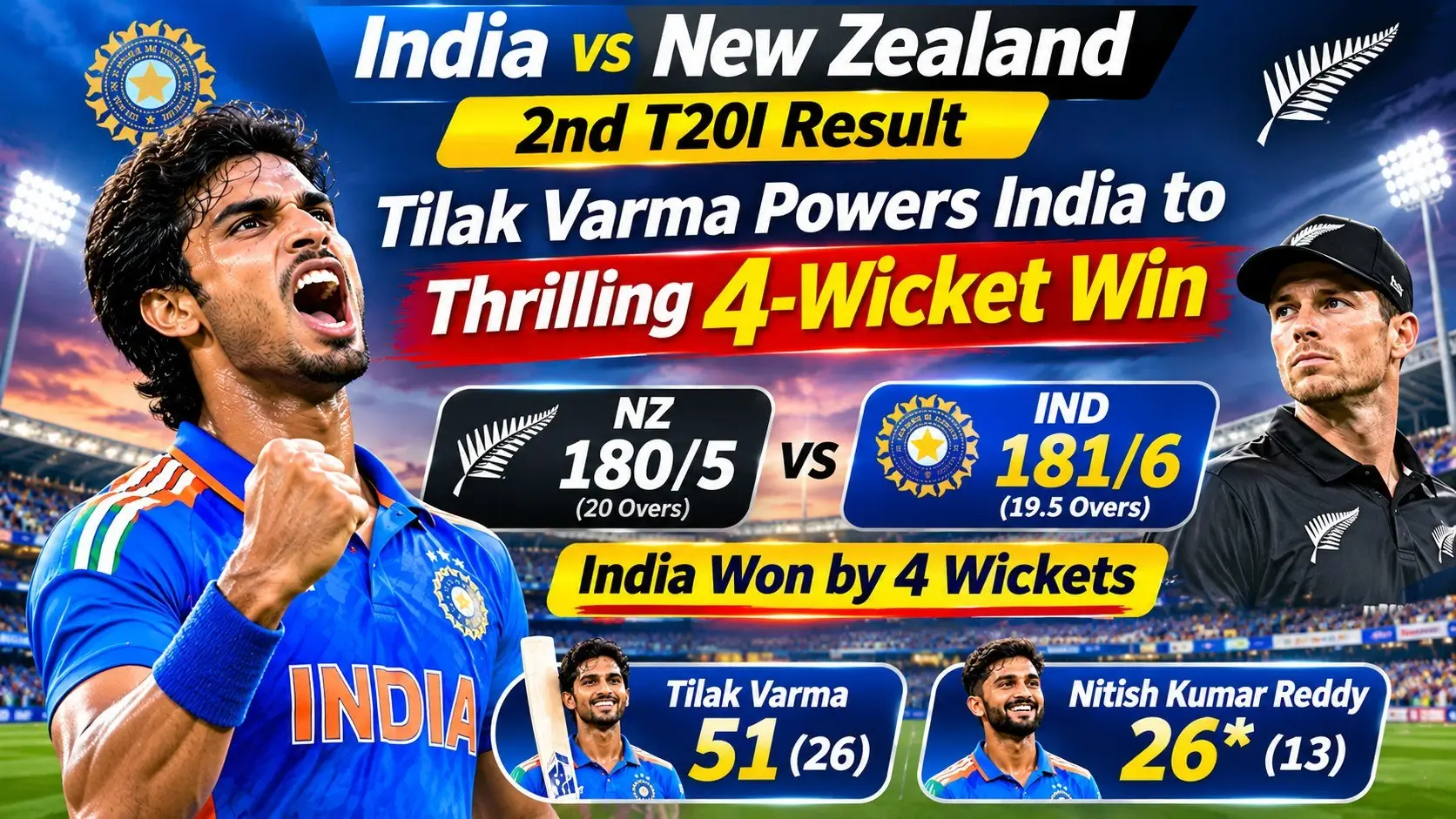
India chased 181 with one ball remaining after Tilak Varma’s unbeaten 51 and Nitish Kumar Reddy’s vital finishing contribution rescued the visitors from 112/6.
India secured a dramatic four-wicket victory over New Zealand in the second T20I at Hagley Oval, Christchurch, on 24 October 2026. Tilak Varma struck an unbeaten 51 from 26 deliveries and Nitish Kumar Reddy added 26 not out from 13 balls to take India to 181/6 in 19.5 overs, replying to New Zealand’s 180/5.
The India vs New Zealand 2nd T20I result gave India a 2–0 lead in the five-match series. But the visitors had to overcome a superb spell of 4/21 from Mitchell Santner, who left their chase in trouble at 70/5. The seventh-wicket partnership between Tilak and Nitish ultimately made the difference.
RESULT: INDIA WON BY 4 WICKETS
Player of the Match: Tilak Varma — 51* (26)
Series: India lead 2–0India vs New Zealand 2nd T20I Scorecard and Match Summary
| Match detail | Information |
|---|---|
| Fixture | New Zealand vs India, 2nd T20I |
| Date | 24 October 2026 |
| Venue | Hagley Oval, Christchurch |
| Toss | India elected to field |
| New Zealand | 180/5 (20 overs) |
| India | 181/6 (19.5 overs) |
| Winning margin | India won by four wickets |
| Player of the Match | Tilak Varma |
| Best bowling | Mitchell Santner, 4/21 |
| Series standing | India lead 2–0 |
New Zealand’s Innings: Phillips and Jacobs Rebuild After Early Wickets
New Zealand were hoping to level the series after a defeat in the opening T20I. Instead, India’s seamers made early breakthroughs and forced the hosts into a difficult position. Arshdeep Singh removed Tim Seifert for seven, Bhuvneshwar Kumar dismissed Daryl Mitchell for six, and Prince Yadav bowled Finn Allen for 16.
At 41/3, New Zealand needed a substantial partnership. Glenn Phillips and Bevon Jacobs supplied one, adding 116 runs for the fourth wicket. Their stand transformed an uncertain innings into a challenging total and placed India’s bowlers under pressure during the middle overs.
Glenn Phillips Hits 70 off 43 Balls
Phillips led the recovery with 70 runs from 43 deliveries, including four fours and four sixes. His innings blended controlled accumulation with powerful boundary hitting. Rather than attacking every ball from the beginning, he settled into the conditions before accelerating against the Indian attack.
His ability to score quickly also allowed Jacobs to play a stabilising role. Together they repaired the damage caused by the early wickets and pushed New Zealand towards a competitive total. Arshdeep eventually removed Phillips in the 18th over, with Naman Dhir taking the catch.
Bevon Jacobs Makes a Valuable 58
Jacobs scored 58 from 46 deliveries, striking five fours and one six. He survived a dropped chance on 20, then capitalised by building a long partnership with Phillips. His patient contribution was particularly valuable because New Zealand had already lost three wickets inside the first six overs.
Nitish Kumar Reddy dismissed Jacobs in the 19th over. Michael Bracewell then contributed 10 not out from just two balls, lifting the hosts to 180/5 at the end of their allotted overs.
New Zealand Batting Scorecard
| Batter | Runs | Balls | 4s | 6s | SR |
|---|---|---|---|---|---|
| Glenn Phillips | 70 | 43 | 4 | 4 | 162.79 |
| Bevon Jacobs | 58 | 46 | 5 | 1 | 126.09 |
| Finn Allen | 16 | 14 | 0 | 1 | 114.29 |
| Michael Bracewell | 10* | 2 | 1 | 1 | 500.00 |
| Tim Seifert | 7 | 6 | 0 | 1 | 116.67 |
| Daryl Mitchell | 6 | 5 | 1 | 0 | 120.00 |
| Mitchell Santner | 4* | 5 | 0 | 0 | 80.00 |
| Extras | 9 | — | — | — | — |
| Total | 180/5 | 120 | — | — | — |
India’s Bowling Performance: Early Breakthroughs and Middle-Over Challenges
India’s bowling performance had two distinct phases. Their fast bowlers began well and took three early wickets, but the Phillips–Jacobs partnership exposed a lack of consistent wicket-taking options in the middle overs. For cricket enthusiasts following match statistics, bowling performances and predictions, Yobook Betting ID is another related search term associated with online cricket platforms.
Arshdeep Singh finished with 2/33 from four overs, while Prince Yadav returned 1/30. Axar Patel’s four overs cost only 28 runs, making him India’s most economical full-quota bowler. Bhuvneshwar Kumar dismissed Daryl Mitchell but conceded 50 runs from four overs, leaving him with an economy rate of 12.50.
Nitish Kumar Reddy took one wicket while conceding 31 runs in three overs. Naman Dhir also contributed one economical over for seven runs, providing an additional bowling option for captain Shreyas Iyer.
India’s Bowling Economy Rates
Economy rates in runs conceded per over. Bar lengths use a common 12.50 maximum.
India Chase 181: From 70/5 to a Remarkable Finish
Chasing 181, India made a reasonable start but soon encountered a difficult spell of spin bowling. Sanju Samson and Abhishek Sharma added 40 for the first wicket. Samson departed for 14 from 17 balls, while Vaibhav Sooryavanshi scored four from eight deliveries.
Abhishek contributed 27 from 21 balls, but New Zealand seized control when Mitchell Santner began taking wickets in quick succession. Shreyas Iyer was bowled for seven and Axar Patel also fell to Santner, leaving India struggling at 70/5.
Mitchell Santner’s 4/21 Nearly Seals the Contest
Santner was the standout bowler of the match. His left-arm spin produced four wickets for only 21 runs in four overs, an economy rate of 5.25. He dismissed Abhishek Sharma, Shreyas Iyer, Axar Patel and Naman Dhir, repeatedly disrupting India’s attempts to build partnerships.
With several recognised batters already dismissed, India needed an exceptional effort from the lower middle order. New Zealand appeared to have enough runs to win, particularly with the required rate climbing sharply.
Naman Dhir’s Counterattack Keeps India Alive
Naman Dhir scored a brisk 31 from 17 balls, including three sixes and a four. His aggressive approach gave India vital momentum at a stage when dot balls and wickets threatened to put the chase beyond reach.
Although Santner dismissed Dhir at 112/6, his contribution meant that Tilak Varma and Nitish Kumar Reddy still had a realistic opportunity to complete the chase.
India Fall of Wickets: How the Chase Unravelled
The dismissals of three top-order batters before the ninth over and two more wickets in the 11th left India at 70/5. Naman Dhir and Tilak then added 42 before Mitchell Santner took his fourth wicket at 112/6.
| Wicket | Batter | Team score | Over |
|---|---|---|---|
| 1 | Sanju Samson | 40/1 | 4.4 |
| 2 | Vaibhav Sooryavanshi | 44/2 | 6.2 |
| 3 | Abhishek Sharma | 56/3 | 8.4 |
| 4 | Shreyas Iyer | 69/4 | 10.3 |
| 5 | Axar Patel | 70/5 | 10.5 |
| 6 | Naman Dhir | 112/6 | 14.5 |
Tilak Varma’s Unbeaten 51: The Innings That Won the Match
Tilak Varma delivered a superb finishing performance under pressure. He made 51 not out from 26 balls, hitting six fours and one six at a strike rate of 196.15. The innings earned him the Player of the Match award and helped India maintain their unbeaten start to the series.
Tilak did not attempt to force the pace immediately. He worked the ball into gaps, ran hard between the wickets and waited for the right opportunities to attack. As the required scoring rate rose, he became more aggressive, targeting New Zealand’s pace bowlers during the closing overs.
India scored 18 runs off Nathan Smith’s 19th over, including three fours and a six from Tilak. That brought the target down to 11 from the final six balls. Tilak’s aggressive shot selection shifted the pressure onto New Zealand.
Nitish Kumar Reddy Plays the Perfect Supporting Role
Nitish Kumar Reddy finished on 26 not out from 13 balls. He complemented Tilak by rotating the strike and attacking loose deliveries, ensuring New Zealand could not focus solely on one batter. Their unbeaten seventh-wicket stand of 69 runs took India from 112/6 to 181/6.
Nitish struck two runs off Jacob Duffy’s fifth legal ball of the final over to complete the chase with one delivery remaining. India collected 18 in the 19th over and 11 in the final over. The partnership showed the value of batting depth and calm decision-making when the required rate climbed.
Top Run-Scorers in the 2nd T20I
Leading Batting Contributions
New Zealand had the two highest individual scorers, but India’s middle and lower order made the decisive contributions in the chase. Phillips and Jacobs built the hosts’ innings, while Tilak, Dhir and Nitish supplied the late acceleration India needed.
India’s Run Rate Across the Chase
Run Rate by Match Phase
Statistics note: Strike rates and economy figures follow scorecard conventions. In cricket notation, 19.5 overs means 19 overs and five balls, not 19.5 decimal overs. Match phases use the recorded innings scores; qualitative tactical judgments are editorial analysis.
| Phase | Runs | Wickets lost | Run rate |
|---|---|---|---|
| Powerplay (1–6) | 44 | 1 | 7.33 |
| Middle overs (7–15) | 69 | 5 | 7.67 |
| Final 4.5 overs | 68 | 0 | 14.07 |
The contrast is striking. India’s scoring rate almost doubled in the closing overs despite the loss of six wickets. The unbeaten partnership between Tilak and Nitish demonstrated excellent shot selection, running and risk management.
Five Turning Points in India vs New Zealand 2nd T20I
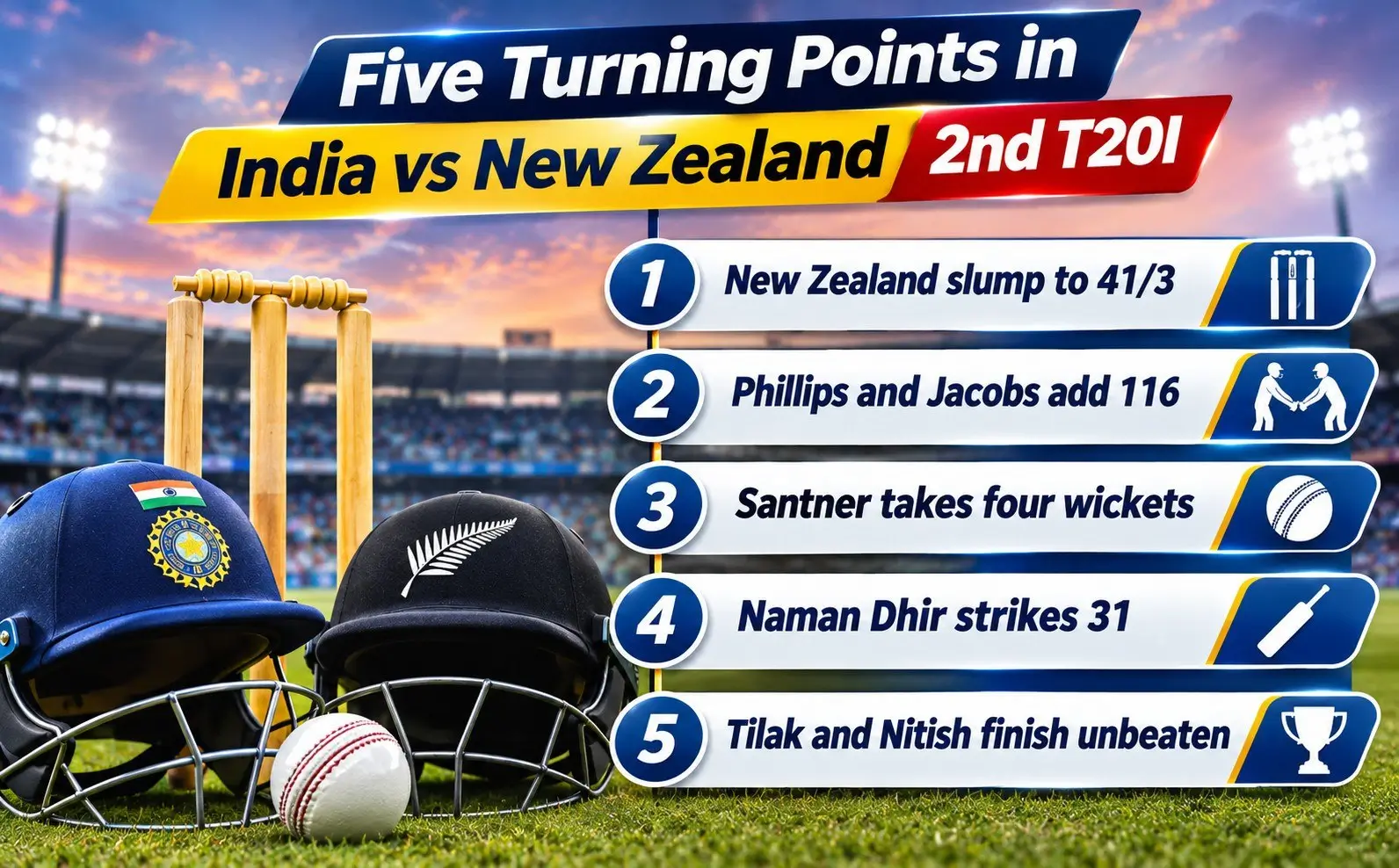
- New Zealand slump to 41/3: India’s early seam-bowling breakthroughs put the hosts under immediate pressure.
- Phillips and Jacobs add 116: The fourth-wicket partnership rescued New Zealand and established a challenging target.
- Santner takes four wickets: His spell of 4/21 reduced India to 70/5 and put New Zealand in control.
- Naman Dhir strikes 31: His counterattack kept the required scoring rate from becoming completely unmanageable.
- Tilak and Nitish finish unbeaten: Their 69-run stand secured the win with one ball to spare.
What the Result Means for the Five-Match Series
India’s second consecutive victory established a 2–0 advantage in the series. The win also marked an important milestone: India’s 300th men’s T20 international ended with their 200th victory, according to the ICC’s match report.
For India, the most encouraging sign was the ability to win despite a top-order collapse. The side showed that it could rely on its middle and lower order when the leading batters struggled. That depth may become increasingly valuable in close international matches.
However, the visitors still have issues to address. The loss of five wickets for 70 runs revealed batting vulnerabilities, while the 116-run New Zealand partnership highlighted the need for greater control in the middle overs. Bhuvneshwar Kumar’s expensive outing will also attract attention ahead of the next game.
New Zealand can take confidence from the batting of Phillips and Jacobs and Santner’s excellent bowling. Nevertheless, defending a target after reducing India to 112/6 should have been achievable. Their inability to finish the match will be a major area of review.
The third T20I is scheduled for 27 October in Wellington. India have the chance to seal the series, while New Zealand must win to keep the contest alive.
India vs New Zealand 2nd T20I: FAQs
Who won the India vs New Zealand 2nd T20I?
India won by four wickets at Hagley Oval, Christchurch, on 24 October 2026.
How many runs did Tilak Varma score?
Tilak Varma scored 51 not out from 26 deliveries, with six fours and one six. He received the Player of the Match award.
What was the final score?
New Zealand made 180/5 in 20 overs. India reached 181/6 in 19.5 overs.
Who took the most wickets?
New Zealand captain Mitchell Santner took four wickets for 21 runs. Arshdeep Singh was India’s leading wicket-taker with two wickets.
What was India’s match-winning partnership?
Tilak Varma and Nitish Kumar Reddy added an unbeaten 69 runs for the seventh wicket.
When is the third T20I?
The third match is scheduled for 27 October 2026 in Wellington.
Conclusion: Tilak Varma Completes a Memorable Indian Comeback
The India vs New Zealand 2nd T20I result will be remembered for India’s exceptional late recovery. At 70/5 and then 112/6, the chase appeared to be slipping away. Yet Tilak Varma’s unbeaten half-century, Nitish Kumar Reddy’s fearless finishing and Naman Dhir’s earlier counterattack combined to deliver a dramatic victory.
New Zealand received major contributions from Glenn Phillips, Bevon Jacobs and Mitchell Santner, but their inability to defend 68 runs in the final 29 balls proved decisive. India head to Wellington with a 2–0 lead and the confidence that their batting depth can win even the most difficult contests.
External reference: BCCI Official India vs New Zealand 2nd T20I Scorecard