
CRICKET MATCH PREVIEW • UPDATED 26 OCTOBER 2026

India are one victory away from clinching the five-match T20I series against New Zealand, but the hosts have an opportunity to change the narrative when the teams meet in Wellington on October 27, 2026. The NZ vs IND 3rd T20I prediction is particularly interesting because India’s two victories in Christchurch were far from comfortable.
Shreyas Iyer’s India lead the series 2-0 after winning both matches by four wickets. New Zealand have created winning opportunities in each contest but failed to finish strongly enough. Mitchell Santner’s team must now win the third T20I to keep the series alive.
Wellington introduces another challenge: different ground dimensions, potentially influential wind conditions and a fresh tactical contest between India’s aggressive batting unit and New Zealand’s experienced spin attack.
India enter as favourites because of their batting depth and ability to recover from difficult positions. However, New Zealand’s home advantage, Santner’s bowling form and India’s concerns with the ball mean the third T20I could be another close encounter.
NZ vs IND 3rd T20I 2026: Match Details
| Match information | Details |
|---|---|
| Match | New Zealand vs India, 3rd T20I |
| Series | India Tour of New Zealand 2026 |
| Date | Tuesday, October 27, 2026 |
| Venue | Hnry Stadium (Sky Stadium), Wellington |
| Start time | 12:30 PM IST / 8:00 PM NZDT |
| India captain | Shreyas Iyer |
| New Zealand captain | Mitchell Santner |
| Series standing | India lead 2-0 |
| Live streaming in India | SonyLIV |
| TV broadcast | Sony Sports Network |
NZ vs IND T20I Series 2026: Results So Far
The opening two matches have produced two dramatic Indian run chases, highlighting both India’s finishing ability and New Zealand’s inability to protect strong positions.
| Match | New Zealand | India | Result |
|---|---|---|---|
| 1st T20I, Christchurch | 225/4 | 226/6 | India won by 4 wickets |
| 2nd T20I, Christchurch | 180/5 | 181/6 | India won by 4 wickets |
| 3rd T20I, Wellington | — | — | October 27 |
Bars represent runs scored (scale: 250 runs).
The totals demonstrate how little separates the teams on batting production. India have scored exactly one run more than New Zealand in each chase, although both innings ended with wickets and deliveries remaining.
That makes New Zealand’s finishing problems especially important. A stronger final five overs with either bat or ball could dramatically alter the third match.
How India Won the First Two T20Is
First T20I: India chase 226 in Christchurch
New Zealand posted an imposing 225/4 in the series opener, putting considerable pressure on India’s batting unit. The visitors nevertheless completed the chase with four wickets remaining.
The match exposed India’s expensive bowling performance, but it also demonstrated the depth of their batting order. New Zealand’s inability to defend a total above 220 became an immediate concern.
For India, the victory offered encouragement without removing the need to improve their bowling execution.
Second T20I: Tilak Varma leads another remarkable comeback
The second match followed a different pattern. New Zealand scored 180/5 before Santner’s bowling threatened to deliver the hosts their first victory.
India required 68 runs from the final five overs, a difficult equation against a team with experienced death-over options.
Tilak Varma responded with an unbeaten 51 from 26 deliveries, while Nitish Kumar Reddy contributed to the recovery. India reached 181/6 with one ball remaining.
Santner’s four-wicket performance had put New Zealand in a strong position, but India’s lower-middle-order resilience ultimately decided the contest.
NZ vs IND 3rd T20I Pitch Report: Wellington Conditions

Hnry Stadium in Wellington presents a different tactical environment from Christchurch. Its exposed setting means wind can become an important factor, especially for high catches, bowling accuracy and aerial stroke-making.
Batters may benefit from consistent bounce if the surface is firm, while seamers could find assistance when the ball is new. However, actual movement and scoring conditions will depend on the prepared pitch and weather on match day.
What can batters expect?
India’s aggressive batters will look to capitalise on the powerplay, but they must assess the wind direction before attempting repeated lofted shots.
Wellington’s boundaries and changing wind conditions can influence which areas are safest for attacking cricket. Straight hitting, strike rotation and choosing the right bowlers to target could be particularly important.
Will fast bowlers or spinners dominate?
New Zealand’s seamers may benefit from the new ball, while India’s quicks will hope for more control than they displayed earlier in the series.
Spin remains important because Santner has already demonstrated his ability to interrupt India’s momentum. His variations in pace and trajectory could be effective even if the pitch offers limited turn.
Expected first-innings score
A possible competitive range on a good batting surface, not a verified historical Wellington average.
A total around 180 could create a competitive contest, but the previous two matches suggest neither team can assume a target is safe.
The toss may influence decisions if captains anticipate changing conditions. Nevertheless, the first two T20Is show that bowling execution is likely to matter more than simply choosing to bat or field.
NZ vs IND 3rd T20I Predicted Playing XI
Both teams have important selection decisions before the Wellington encounter. India must manage Ishan Kishan’s absence, while New Zealand need a bowling combination capable of containing India’s powerful middle order.
India predicted playing XI
| No. | Player | Expected role |
|---|---|---|
| 1 | Sanju Samson | Wicketkeeper-batter |
| 2 | Abhishek Sharma | Opening batter |
| 3 | Vaibhav Sooryavanshi | Top-order batter |
| 4 | Shreyas Iyer (C) | Middle-order batter |
| 5 | Tilak Varma | Middle-order batter |
| 6 | Nitish Kumar Reddy | Batting all-rounder |
| 7 | Naman Dhir | Batting all-rounder |
| 8 | Axar Patel | Spin all-rounder |
| 9 | Bhuvneshwar Kumar | Fast bowler |
| 10 | Arshdeep Singh | Left-arm fast bowler |
| 11 | Varun Chakaravarthy | Mystery spinner |
Editorial projection, not a confirmed XI. Mayank Yadav, Kuldeep Yadav and Prince Yadav are among the alternatives.
New Zealand predicted playing XI
| No. | Player | Expected role |
|---|---|---|
| 1 | Tim Seifert | Wicketkeeper-batter |
| 2 | Finn Allen | Opening batter |
| 3 | Daryl Mitchell | Top-order batter |
| 4 | Glenn Phillips | Middle-order batter |
| 5 | Bevon Jacobs | Middle-order batter |
| 6 | Michael Bracewell | All-rounder |
| 7 | Mitchell Santner (C) | Spin all-rounder |
| 8 | Nathan Smith | Seam-bowling all-rounder |
| 9 | Kyle Jamieson | Fast bowler |
| 10 | Jacob Duffy | Fast bowler |
| 11 | Adam Milne | Fast bowler |
Editorial projection subject to availability and final team selection.
Ishan Kishan Ruled Out: What Does It Mean for India?
India have suffered a notable selection setback ahead of the third T20I. Ishan Kishan has been ruled out of the Wellington match because of a low-grade right adductor strain sustained during the first T20I.
Kishan has not yet regained full match fitness. Kumar Kushagra has joined the squad as wicketkeeping cover, while Vaibhav Sooryavanshi, who occupied the No. 3 position in the second match, could retain that role.
Kishan’s absence reduces India’s batting options and places additional responsibility on the available top-order players. However, the success of India’s middle order in Christchurch suggests the visitors have enough depth to remain competitive.
The key question is whether India can establish a stronger foundation rather than repeatedly depending on late recoveries.
Pressure on Vaibhav Sooryavanshi Ahead of the Third T20I
Vaibhav Sooryavanshi is one of the most intriguing players in India’s current T20I setup. His attacking approach offers the potential to change a match within a few overs, but international cricket also demands adaptability.
With Kishan unavailable, the youngster could receive another opportunity at No. 3.
New Zealand may challenge him with early pace, changing lengths and Santner’s spin. Rather than attacking every delivery, Sooryavanshi will need to identify favourable matchups and rotate the strike when boundaries become difficult.
His performance could influence India’s powerplay-to-middle-overs transition. A positive innings would reduce the pressure on Shreyas Iyer and Tilak Varma.
Can Bhuvneshwar Kumar Rediscover His Bowling Rhythm?
Bhuvneshwar Kumar’s experience remains valuable, particularly in conditions where the new ball may move. However, India’s pace attack needs greater control after conceding substantial runs in the opening matches.
Bhuvneshwar’s traditional strengths include swing, variations in length and slower deliveries. Wellington offers another opportunity to demonstrate those skills.
India must also consider whether additional pace from Mayank Yadav would be more effective. The selection decision should depend on the pitch, wind conditions and the team’s preferred bowling combinations.
For Bhuvneshwar, the objective is straightforward: take early wickets without allowing New Zealand’s openers to dominate the powerplay.
NZ vs IND Head-to-Head Record in T20 Internationals
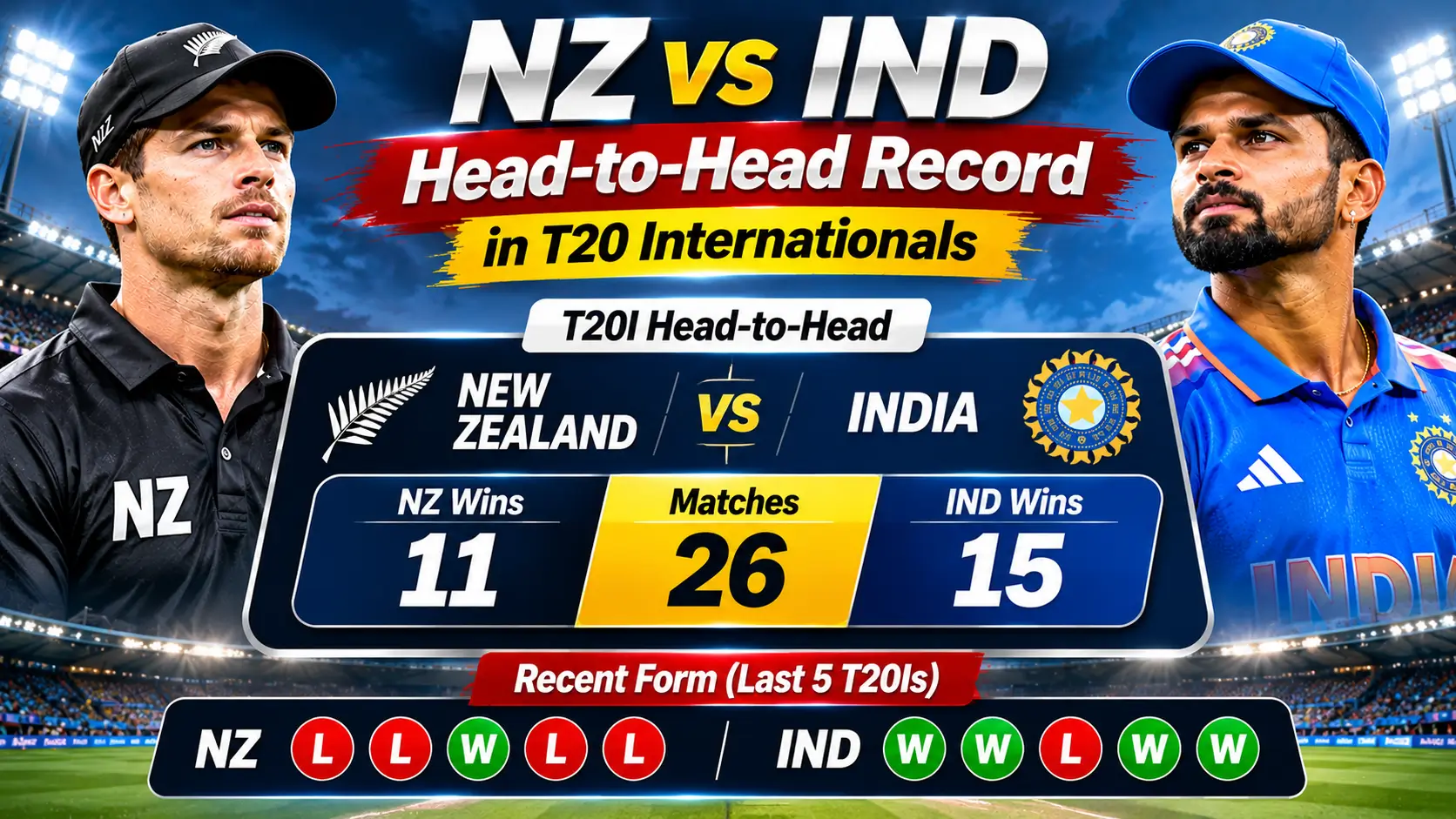
India hold the stronger overall record against New Zealand in men’s T20 internationals. The reported head-to-head figures following the second T20I show India with 21 wins, New Zealand with 11, and three tied matches.
35 contests including tied matches; bar widths show shares of total.
The historical advantage supports India’s position as favourites, but it does not guarantee victory. New Zealand have repeatedly shown they can challenge India, particularly when their spinners control the middle overs.
The third T20I is also being played in New Zealand, where familiarity with local conditions could help the hosts.
Key Player Battles That Could Decide the Third T20I
Abhishek Sharma vs New Zealand’s new-ball attack
Abhishek Sharma’s aggressive opening style can put New Zealand under pressure immediately. However, the hosts could counter by targeting his stumps and forcing him to play against movement.
Early wickets would help New Zealand prevent another explosive Indian chase.
Tilak Varma vs Mitchell Santner
This is potentially the defining contest of the match. Tilak’s match-winning innings in the second T20I demonstrated his ability to handle pressure, while Santner’s four wickets showed how effectively he can disrupt India’s batting.
If Santner dismisses Tilak early, New Zealand may expose India’s finishing resources sooner than expected.
Glenn Phillips vs India’s spin attack
Glenn Phillips offers New Zealand aggressive middle-order batting and excellent fielding. India must prevent him from building partnerships with Daryl Mitchell and Michael Bracewell.
Axar Patel and Varun Chakaravarthy could be important in restricting Phillips through the middle overs.
What New Zealand Must Do to Stop India’s Winning Streak
New Zealand’s biggest problem is not creating winning positions; it is converting them into victories.
The hosts have already demonstrated that they can post competitive totals and take wickets against India’s batting lineup. Their challenge is to sustain that performance throughout 20 overs.
First, New Zealand need to make better use of their powerplay opportunities. Removing India’s top three early would force the visitors to rebuild rather than attack freely.
Second, Santner and Bracewell must control the middle overs. India’s batting depth is considerable, but dot-ball pressure can still create mistakes.
Finally, New Zealand must improve their death bowling and fielding. Their inability to defend 68 runs from the final five overs in the second T20I illustrates the cost of late mistakes.
If the hosts address these three areas, the third T20I could become their strongest opportunity to reverse the series momentum.
What India Must Improve Before the Wellington Match
Despite their 2-0 advantage, India have areas requiring attention.
Their bowling has allowed New Zealand to build substantial totals, while their batting has experienced difficult phases before producing dramatic recoveries.
India should aim to take wickets earlier, reduce boundary opportunities in the final overs and establish stronger top-order partnerships.
Naman Dhir and Nitish Kumar Reddy provide flexibility, but their contributions should support a stable batting strategy rather than repeatedly rescue difficult situations.
Shreyas Iyer’s captaincy will also be tested. Choosing when to introduce spin, how to manage his seamers and which field placements to use against aggressive batters could make the difference.
NZ vs IND 3rd T20I Match Prediction: Who Will Win?
India have the stronger recent results, greater demonstrated batting depth and confidence from two successful chases. New Zealand, meanwhile, have home advantage and a bowling attack capable of causing problems.
Independent editorial estimates, not bookmaker odds or statistically calibrated probabilities.
Why India are favourites
India have demonstrated an ability to recover from challenging situations. Their middle order has already delivered under pressure, and their confidence should be high after taking a commanding series lead.
However, their bowling vulnerabilities and Kishan’s absence prevent this from being a one-sided prediction.
How New Zealand could win
New Zealand’s clearest route to victory is through early wickets and sustained bowling discipline.
If Santner repeats his second-match impact and the seamers execute their plans in the final overs, the hosts could successfully defend a competitive total.
New Zealand remain capable of an upset, especially if Wellington conditions favour their bowlers.
Readers researching cricket-related online platforms may also encounter the term Yobook betting ID. This is a separate topic from the match prediction and does not influence the editorial assessment above.
Where to Watch NZ vs IND 3rd T20I Live
Indian viewers can watch the match on Sony Sports Network, with online streaming available through SonyLIV. The contest is scheduled to begin at 12:30 PM IST on October 27.
For official fixture details, team announcements and match updates, visit the BCCI’s official NZ vs IND 3rd T20I match centre.
Frequently Asked Questions
Who will win the NZ vs IND 3rd T20I?
India are the predicted winners based on their 2-0 series lead, batting depth and recent finishing performances. New Zealand could still win if their bowling improves.
When is the India vs New Zealand 3rd T20I?
The third T20I takes place on Tuesday, October 27, 2026, starting at 12:30 PM IST.
Where will the NZ vs IND 3rd T20I be played?
The match will be played at Hnry Stadium, also known as Sky Stadium, in Wellington, New Zealand.
Is Ishan Kishan playing the third T20I?
No. Kishan has been ruled out while recovering from a right adductor strain.
Can New Zealand still win the T20I series?
Yes. New Zealand must win all three remaining matches to take the series 3-2. Another Indian victory would give India an unassailable 3-0 lead.
Final Verdict: Can New Zealand Stop India?
The third T20I represents a crucial moment for both teams. India have the opportunity to seal the series, while New Zealand must produce a complete performance to avoid a third consecutive defeat.
The opening two matches have shown that the difference between these sides is smaller than the series scoreline suggests. New Zealand have created opportunities, but India have been better at handling decisive moments.
Wellington’s conditions, Santner’s spin bowling and India’s top-order performance could determine whether the contest follows the same pattern.
For the NZ vs IND 3rd T20I prediction, India remain the stronger choice. Nevertheless, New Zealand’s ability to compete in both previous matches means the visitors should expect another demanding contest rather than an easy series-clinching victory.